
Surprising fact: a platform that markets itself as “one-stop” for centralized exchange services and Web3 tooling can still be best understood as a set of interacting mechanisms — custody models, margin engines, routing logic, and identity gates — not a single product. For a US-based trader who wants to log in, trade spot, and step into futures, the distinctions between those mechanisms determine fees, risk, and how quickly you can react when markets move.
This piece breaks down how OKX stitches together spot trading, margin and futures markets, and account controls. I’ll explain how each part works, where the trade-offs lie, and what practical checks a US trader should run before depositing capital or opening leveraged positions. Expect mechanism-first reasoning, explicit limits, and concrete heuristics that you can reuse.
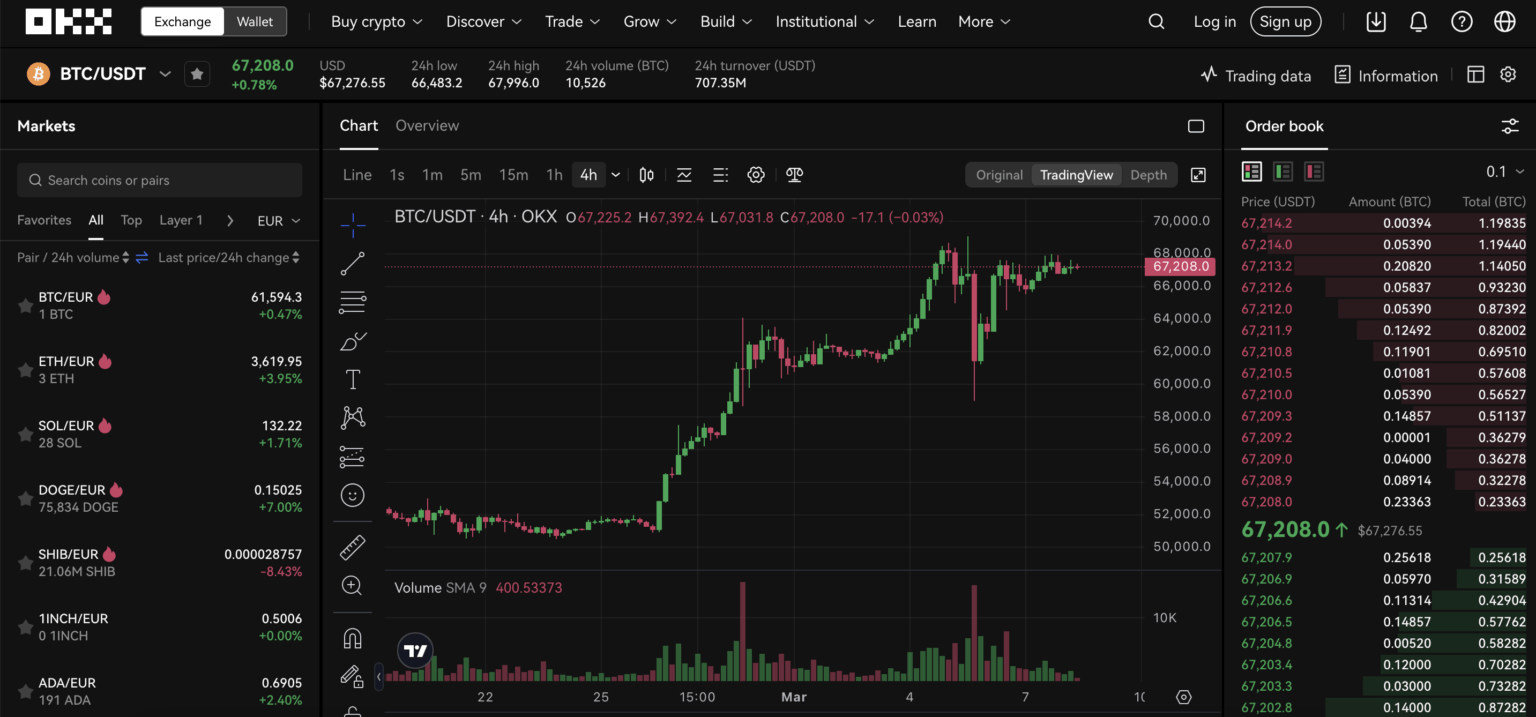
Table of Contents
Core mechanics: spot vs. margin vs. futures on OKX
Spot trading is conceptually simple: you exchange one token for another at prevailing market prices. Mechanically, OKX routes spot orders through its internal order book and, where helpful, its DEX aggregator to source liquidity across Uniswap-like pools for certain swaps. If you use margin, the platform loans you funds and enforces maintenance margin; isolated margin confines risk to a specific pair, while cross-margin pools collateral across positions. The practical difference: in cross-margin, a losing futures position can eat collateral backing your spot holdings.

Futures (perpetual swaps and quarterly contracts) sit on a different ledger inside the exchange. They are not ownership of the underlying asset but cash-settled derivatives whose price tracks a reference. OKX supports up to 125x leverage on some derivatives — a powerful amplifier that changes the math of risk. With high leverage small price moves can wipe your position and cascade to liquidation engines. That’s why understanding funding rates, mark price calculation, and insurance funds matters; these mechanisms determine whether liquidations are orderly or abrupt.
Account entry: KYC, login modes, and what to check first
To trade on OKX you must complete KYC (Know Your Customer) verification: government ID plus facial liveness checks. For US users, this is a gate that’s both regulatory compliance and a security lever — it enables withdrawal approvals but also ties recovery options to identity. OKX offers multiple login vectors: web (TradingView-powered charts), mobile with biometric login, and a browser extension for Web3 interactions. Regardless of channel, mandatory two-factor authentication (2FA) is enforced — SMS, authenticator apps, or biometrics.
If you’re ready to start, bookmark the official login flow and use the platform’s published channels to avoid phishing. For convenience, you can find the exchange entry point here: okx login. Two quick operational checks before you trade: confirm 2FA works on your device, and test a small withdrawal to a self-custodial wallet (or to an exchange you control) to verify withdrawal limits and cold storage liveness.
Security architecture and limits: what cold storage and PoR do — and don’t —solve
OKX stores over 95% of assets in cold, air-gapped, multi-signature wallets. That materially lowers online-exposure attack surface compared with custodial models that keep large hot balances on a single signer. Complementing this, OKX publishes Proof of Reserves (PoR) evidence so users can verify aggregate backing. Together, cold storage plus PoR reduce systemic custody risk but do not eliminate other classes of loss.
What remains: account-level phishing, credential compromise, regulatory seizures, and smart-contract vulnerabilities when you use DeFi bridges or the non-custodial wallet. If you use the self-custodial OKX Web3 wallet, you face the usual seed-phrase risks — losing it is irreversible. In short: PoR and cold storage address exchange solvency and large-scale hacks in principle, but they don’t replace operational hygiene for individual users.
Trading risks and practical mitigations for US traders
Known market risks — volatility, slippage, and liquidity gaps — are amplified by leverage. For example, trading a low-volume alt with a tight stop on 50x leverage can trigger slippage and a larger effective loss than the stop implied. OKX provides order types (limit, stop-limit, reduce-only flags) and margin modes to manage this, but the architecture puts the responsibility on the trader to match order type to market microstructure.
Practical mitigations: 1) Use isolated margin for speculative alt positions so a failed trade cannot drain unrelated collateral. 2) Prefer limit orders in thin books; if you must use market orders during fast moves, reduce size. 3) Understand mark price vs. last price; liquidations reference mark price in many exchanges to avoid manipulation, and that matters for timing stop placements. 4) Monitor funding rates for perpetuals — sustained positive funding makes long positions costly over time.
Spot delistings and what they reveal about market maintenance
Exchanges routinely delist low-volume pairs to protect users from poor liquidity and stale markets. OKX’s recent delisting of several tokens is an example of housekeeping that reduces the risk of order execution failures and extreme bid-ask spreads. For traders this is a reminder: holding obscure tokens on an exchange carries the risk of forced conversion or delayed withdrawal windows. Keep thin holdings in self-custody or be prepared to exit before a delisting notice window closes.
How to think about leverage: a simple decision framework
Here’s a reusable heuristic: size positions first as a percentage of total portfolio (risk-capital), then choose leverage to convert that size into contract exposure. Example: you want max 2% portfolio risk on any single trade. Calculate position size from your stop distance; then pick leverage that allows that notional exposure without turning a small stop into a full-account loss. This flips the common mistake — selecting leverage first, then forcing position size — which often leads to outsized risk.
Also remember the behavioral cost: higher leverage compresses decision time. Liquidation engines and rapid funding changes can make positions self-reinforcing in volatile markets. If you need time to reassess or to wait for liquidity, lower leverage buys you that breathing room.
Where OKX’s ecosystem matters and where it doesn’t
OKX’s integration of CEX, Web3 wallet, DEX aggregator, staking and NFT marketplace creates convenience for cross-product users: you can move between spot, staking, and DeFi without separate logins or bridges. This is powerful if you value speed and unified UX. But convenience concentrates operational risk: a single compromised account can access many services. For US users who value regulatory clarity and insured custody, a centralized platform with KYC and PoR has advantages; for privacy-focused users, non-custodial options remain necessary despite friction.
What to watch next — signals, not predictions
Signals that would change the practical advice here: any material changes to leverage caps, new regulatory guidance affecting derivatives for US customers, or substantial changes to withdrawal process tied to KYC updates. Also watch funding-rate regimes across major perpetuals and liquidity shifts following delistings: both influence cost-to-carry and execution risk. These are not predictions; they are watchpoints. If leverage limits tighten, risk-management heuristics should adjust accordingly.
FAQ
Is OKX available to US residents and what are the KYC requirements?
Yes, OKX operates with identity verification requirements. Account creation involves submitting a government-issued ID and completing a facial recognition liveness check. KYC enables full access to trading and withdrawals but also ties recovery and compliance processes to your verified identity.
What is the difference between spot margin and futures margin on OKX?
Spot margin borrows funds to amplify an actual token purchase; you own the tokens and borrow against them. Futures margin backs derivative positions that are cash-settled and may use isolated or cross-margin depending on product. Mechanically, liquidations behave differently: spot margin liquidations remove leverage and may sell assets, while futures liquidations close contracts and may draw on insurance funds.
How dangerous is 125x leverage and when, if ever, should I use it?
125x leverage is extreme: even tiny price movements can wipe equity. Use it only with microscopic position sizing, in highly liquid markets, and when you fully understand funding and mark price mechanics. For most retail traders, lower leverage preserves decision time and reduces tail-risk.
Does Proof of Reserves mean my assets are fully safe?
PoR increases transparency about aggregate backing and is a helpful signal about solvency. It does not protect against account-level compromises, phishing, regulatory freezes, or smart-contract exploits when you move funds into DeFi. Treat PoR as one part of a broader security picture.
Takeaway: OKX is a layered platform — CEX order books and custody, a Web3 wallet, DEX routing, and derivatives engines — and each layer has distinct mechanisms and failure modes. For US traders the practical path is: secure login and 2FA, understand margin mode before using leverage, prefer isolated margin for speculative bets, and test operational workflows (small deposits/withdrawals) before scaling capital. Those concrete checks convert a good interface into resilient practice.